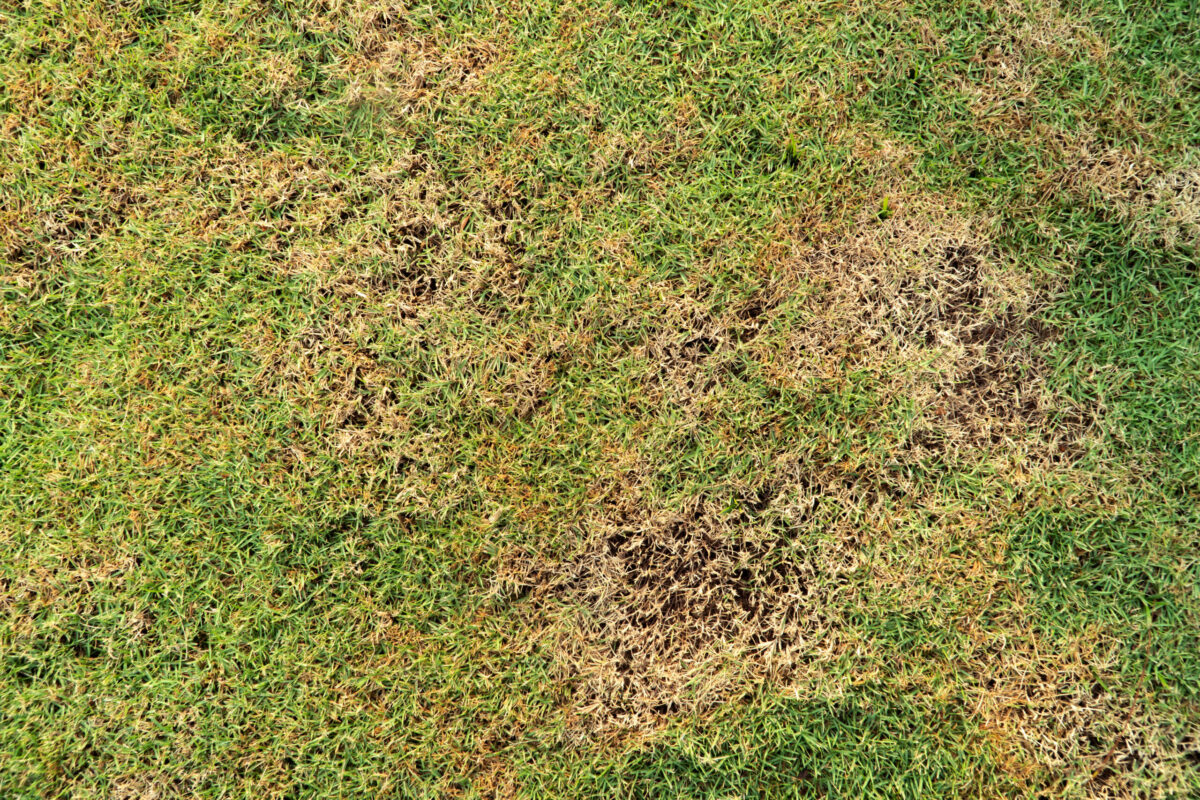
By mid-July, brown is the color of the season across Wichita. Lawns that looked full in May start showing tan, fading areas, and most homeowners reach the same conclusion: the heat finally got to it.
Sometimes that is right, often times though, it’s something else entirely.
Two completely different problems produce nearly identical damage to lawns throughout Wichita and most of Kansas. One is environmental. The other is a living fungal disease that spreads. They look similar enough to be routinely confused, and the treatments that help one can actively make the other worse.
South-central Kansas sits in the transition zone, where weather is too hot for cool-season grasses but too cold for warm-season grasses. In a previous article, we covered why it’s important to pay attention to transition areas and how it affects your lawn; visit our article “How Often Should I Mow My Lawn” for more in-depth information.
Being in a transition zone means fescue and many other native grasses in Kansas are pushed past the temperature-based comfort range. When pushed outside the comfort range, grass will start to experience heat stress.
This is where the second culprit comes into play. July also produces exactly what the fungal pathogen behind brown patch needs: highs in the 80s and 90s, overnight lows above 68 degrees, humidity, and grass that stays wet for hours at a time. So on the same lawn, in the same month, two different problems can turn grass brown. Some years both are happening at once.
Brown patch is a disease, not a weather symptom. The pathogen lives in soil and thatch year-round and turns active when conditions favor it. Once active, it attacks leaf tissue and moves outward through the turf. Damage appears as roughly circular or irregular patches, from a few inches to several feet across, in tan or straw tones. On individual blades, the disease leaves splotches with darker borders. Under heavy humidity in early morning, a grayish ring is sometimes visible at the growing edge.
The critical difference from heat stress is that brown patch is alive and expanding. It does not settle down when the weather moderates. Left alone, patches grow, merge, and thin the turf permanently, leaving bare ground going into fall.
Heat stress is the lawn protecting itself when conditions outpace its ability to take up moisture. No pathogen is involved. Heat stress follows exposure rather than pattern, showing up first where the environment is harshest. Grass often takes on a dull bluish-gray cast before going tan, and blades wilt or curl rather than developing defined lesions. Footprints that stay visible across the lawn are a classic early sign.
We covered this problem in depth in our guide to spotting and treating heat-stressed grass in Wichita, and it remains one of the most common calls we get every summer.
| Brown Patch | Heat Stress | |
|---|---|---|
| Cause | Fungal pathogen | Environmental stress |
| Pattern | Circular or irregular patches with defined edges | Follows sun exposure, slopes, and hard surfaces |
| Blades | Distinct lesions with dark borders | Wilting and curling, no lesions |
| Color | Tan to straw | Bluish-gray shifting to tan |
| Progression | Expands and merges over days | Stabilizes when conditions ease |
| Responds to more water | Often worsens | Usually improves |
Here is the honest caveat: that table explains the difference, but it is not a diagnosis. In the field, these signals overlap constantly. Heat-stressed turf is more vulnerable to infection, so the two frequently appear together on the same property.
Lesions are small and easy to miss, and patch edges blur once damage advances. Reading it correctly means examining individual blades, tracing the pattern across the property, and weighing recent weather, irrigation timing, mowing, and fertilization history. That is diagnostic work, and it is the first thing our team does on every call.
The standard responses to each problem work against each other.
Ultimately, the wrong diagnosis often compounds the damage while the window for an effective response closes.
When we evaluate an affected lawn, we identify what is actually happening and build the response around it. That can include targeted treatment through our lawn treatment program, an irrigation evaluation to correct timing and coverage, core aeration to relieve compaction, and landscaping to improve moisture retention. Just as often, the most valuable result is what we rule out. Knowing your lawn is not diseased saves you from treatments it never needed.
If your lawn is browning and you are not sure why, that uncertainty is the problem worth solving first. The cause determines everything that should happen next, and July leaves little room to test solutions. Our team will evaluate your property, identify what is driving the damage, and put a plan in place to stop it. We serve residential and commercial customers throughout Wichita and the surrounding areas.
Schedule a lawn evaluation or call us at (316) 832-9366.
Pattern and blades are the clearest signals. Brown patch forms defined patches and leaves lesions on the leaf tissue, while heat stress follows sun exposure and causes wilting without lesions. Because the two often occur together, a professional evaluation is the reliable way to know.
It depends on the cause. More water often helps heat-stressed turf and can make brown patch noticeably worse, since the fungus depends on prolonged leaf wetness to spread.
It usually damages leaf tissue rather than killing the crown, so recovery is possible. But severe or repeated outbreaks thin the turf badly, which invites weeds and leaves bare areas heading into fall.
Yes. Tall fescue is the dominant grass here and the most susceptible species, and Kansas summers are hot, meaning the heat, humidity, and warm nights help the disease grow and spread.
